
Let’s Talk About Children Report:
34 Trainings / 698 New Specialists
PURPOSE:
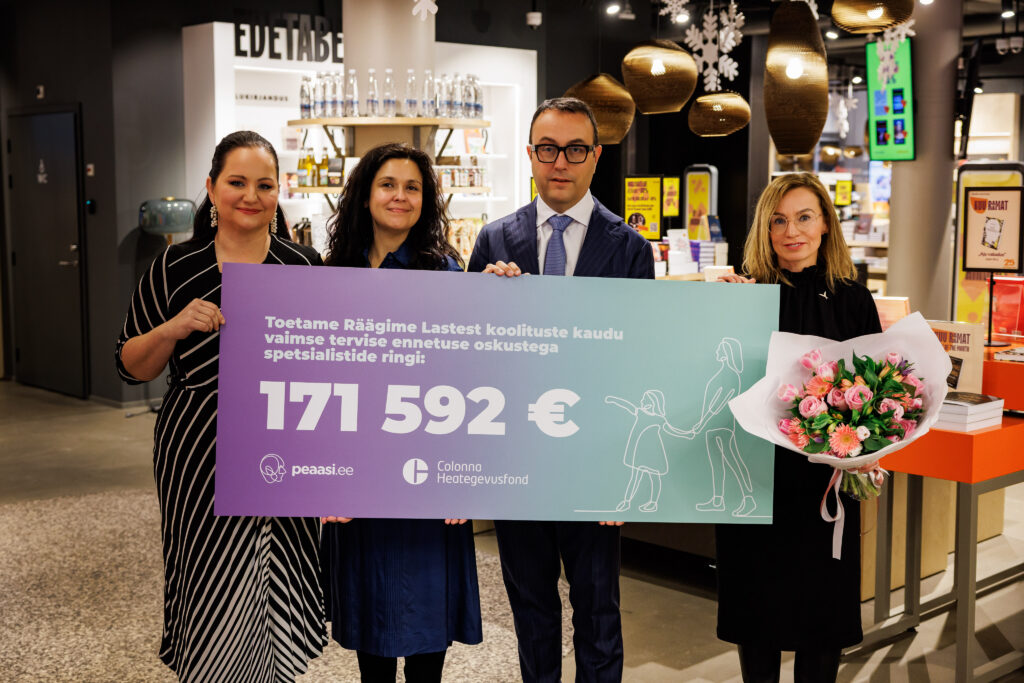
The goal of the joint charity project of the Colonna Charity Foundation and Peaasi.ee was to expand the number of specialists with mental health prevention skills through Let’s Talk About Children user trainings. At the Colonna Charity Gala held in November 2024, €171,592 was raised to train specialists. Peaasi.ee set a goal for the trainings to reach all counties of Estonia.
PROJECT PARTNERS:
In most cases, we planned county-based groups in cooperation with regional health promotion specialists and local government representatives, who have the best regional expertise to assess who the Let’s Talk About Children training should be targeted to.
In addition to regional health promotion specialists, the main partners from Viljandi, Võru, Põlva, Valga, Ida-Viru, Järva, Jõgeva, Rapla, Hiiumaa, and Pärnu counties included: Tartu Education Support Services Centre, Saaremaa Supportive Education Centre, Haapsalu Education Support Services Centre, Narva City Government, Rakvere City Government, Tartu City Government, Elva and Saue municipalities, Tartu University Hospital, the Estonian School Psychologists’ Association, the Estonian Association of Social Pedagogues, the Estonian Play Therapists’ Association, SOS Children’s Village, and the Estonian Play Therapists’ Association.
Some trainings were also held on an institution-specific basis — at Võsu School, Püha Johannese School, and Naerumaa Kindergarten.
TRAINING GROUPS:
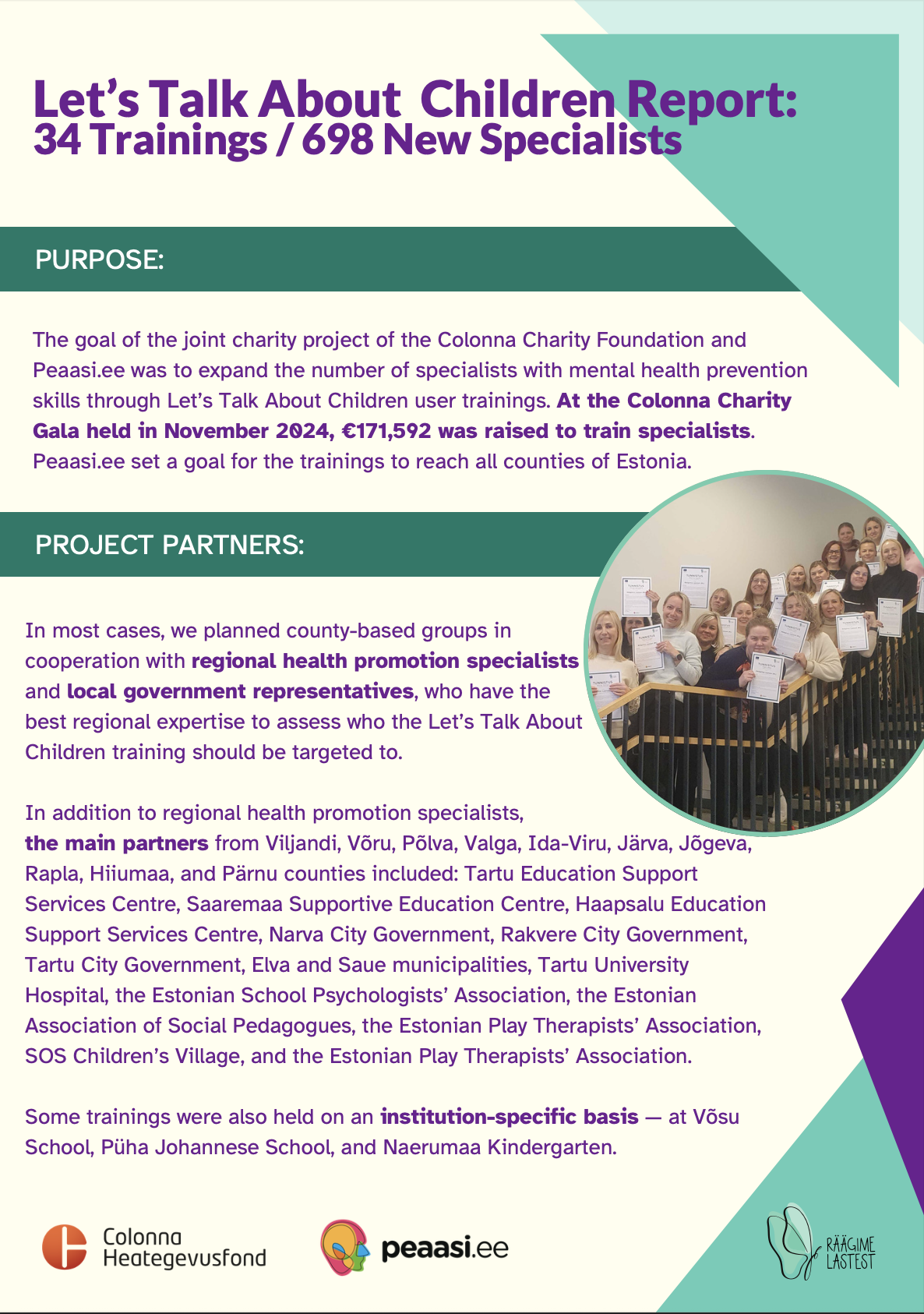
A total of 34 trainings took place as planned, and 698 specialists received training. The new Let’s Talk About Children specialists include, from the field of education, members of kindergarten and school support teams (school psychologists, social pedagogues, special education teachers, etc.), teachers, and class teachers; from the social field, child protection specialists, family support workers, and child well-being specialists; and from the healthcare field, nursing managers, psychologists, counsellors, and others.
IMPACT:
With the support of the foundation’s donations, more than 1,400 families took part in Let’s Talk About Children discussions through the trainings. In addition to the trainings, we actively engaged in awareness-raising and took part in several regional events for local government representatives and educational institutions. Thanks to the foundation and the donations, each region of Estonia now has a critical mass of practitioners and a network of skilled specialists with competencies in preventing mental health difficulties, who will actively continue conducting Let’s Talk About Children discussions in their work.
FOLLOW-UP ACTIVITIES:
We will continue supporting already trained practitioners to ensure the sustainability of the use of Let’s Talk About Children. We are monitoring and collecting data on the implementation of the method. After gaining initial experience, several institutions and regions are ready to invest in training practitioners themselves and are already planning further trainings in order to increase the number of Let’s Talk About Children practitioners in their institution or region.
PARTICIPANT FEEDBACK FROM THE TRAINING:
One support specialist’s feedback captures the impact of the training well: “The training gave me a clear and practical understanding of how to use the Let’s Talk About Children method. I use this approach in my work to better understand the situation of the child and family, notice their needs, and highlight existing strengths. The clear structure of the method helps guide conversations more consciously and reach concrete next steps together with the family in supporting the child. I have noticed that Let’s Talk About Children discussions help create more trusting cooperation with families and support mutual understanding even in more difficult situations. The method also helps families notice their own resources and gives realistic hope for making changes. I consider this approach a valuable long-term investment in the cooperation and well-being of children, parents, and specialists. ”